ePortfolio

Project Overview

A national retail and service company sought to improve how front-line employees responded to challenging customer interactions. Internal surveys showed inconsistent service quality and a lack of confidence when handling complaints. As the Instructional Designer, I was tasked with creating a scalable, interactive learning experience that would help employees develop empathy, active listening, and conflict-resolution skills through scenario-based learning.

The Challenge

Customer feedback reports revealed that associates often followed procedures but failed to communicate empathy or ownership during difficult situations. Managers wanted training that went beyond policy memorization to build real-time decision-making and emotional intelligence.

Key Goal: Reduce customer escalations and boost service-satisfaction scores through an interactive digital course simulating real customer encounters.

My Design Approach (ADDIE Model)

Analysis

I conducted a needs analysis by reviewing call transcripts, mystery-shopper reports, and post-service surveys. Patterns showed that associates needed guidance in tone, phrasing, and emotional regulation rather than factual knowledge.

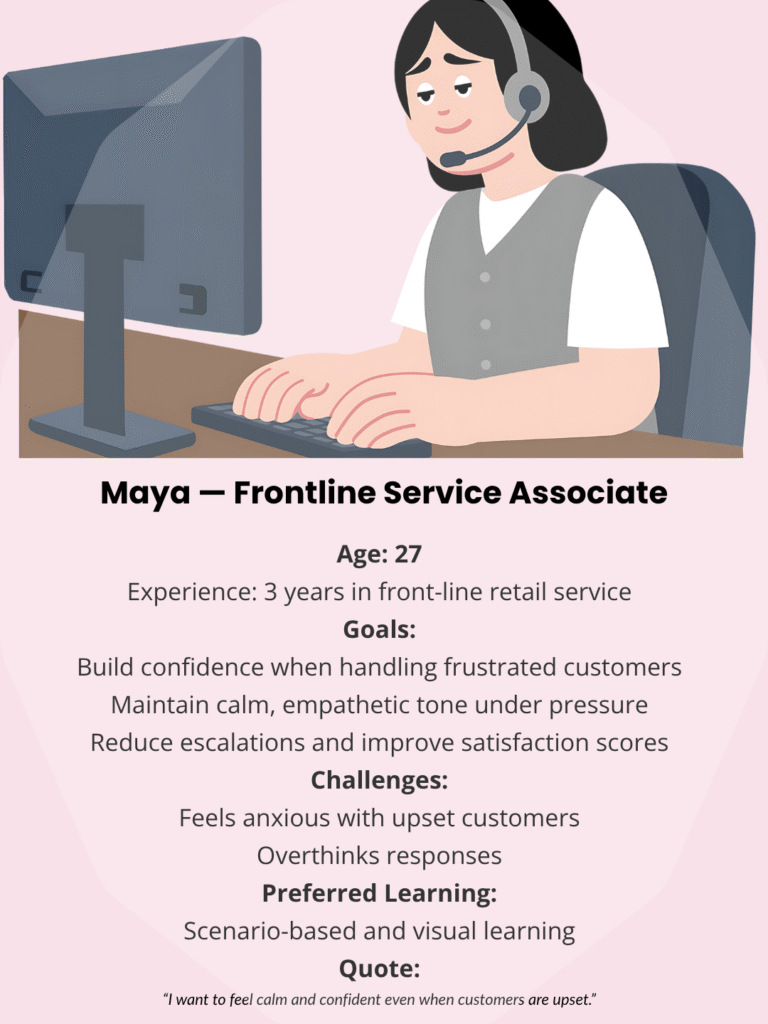
To humanize the data, I created learner personas representing typical associates.

Illustration of Maya, a 27-year-old frontline service associate learning empathy and tone management for customer interactions.

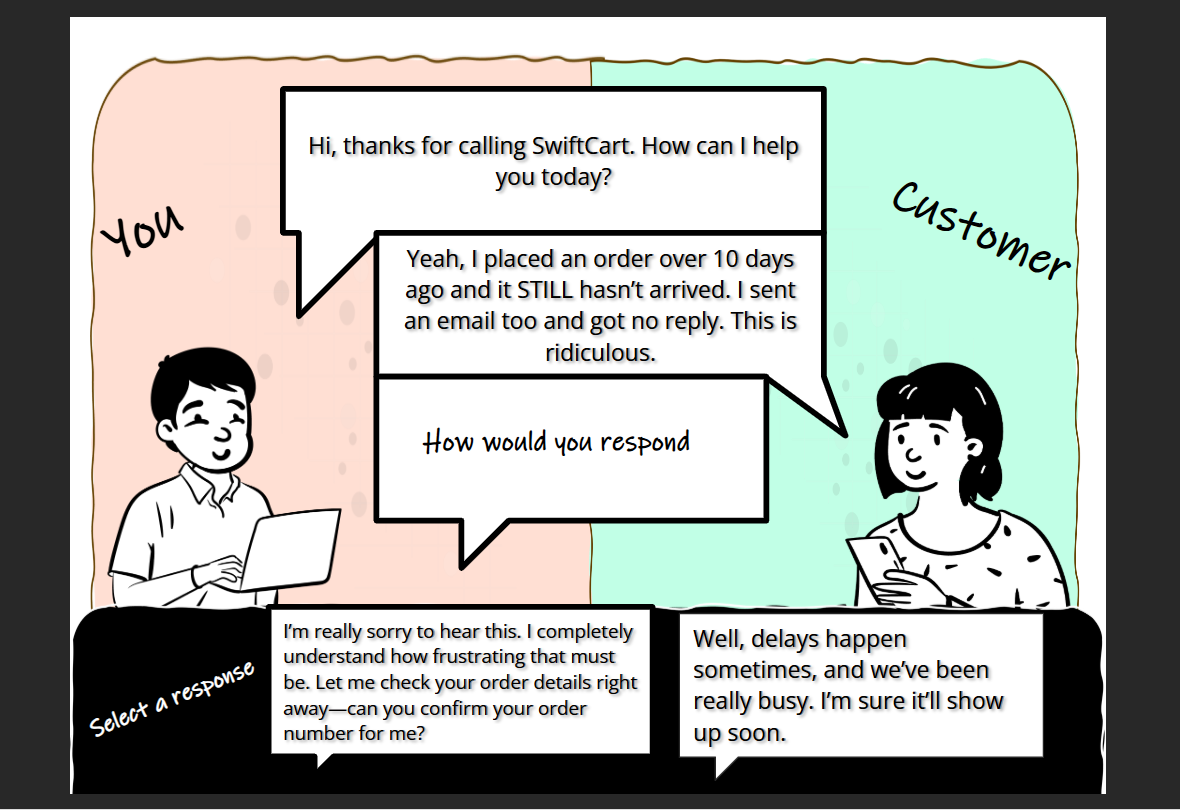
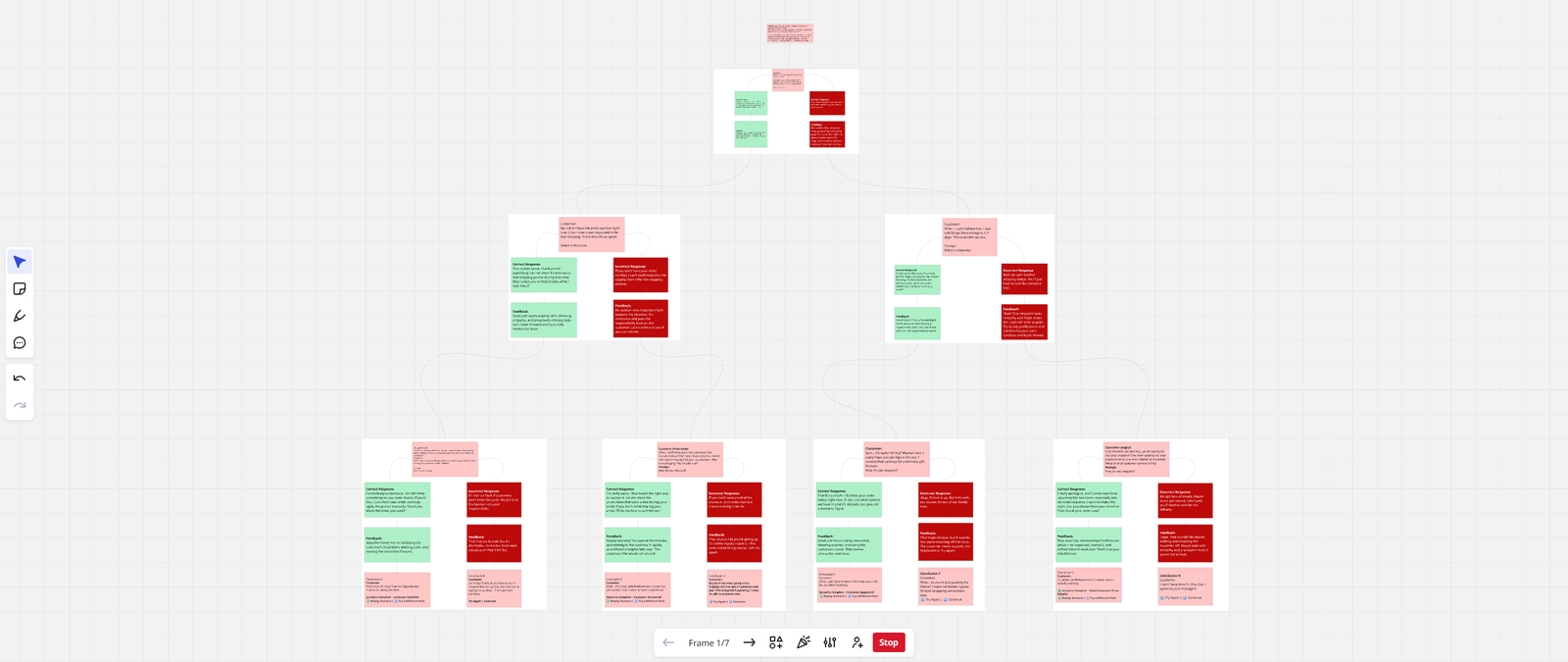
Using insights from the analysis, I designed a branching scenario where learners assumed the role of a service agent interacting with an unhappy customer. Each decision led to different outcomes, mimicking real-life consequences.

Design Highlights:

Branching flow showing learner choices and feedback paths for handling customer complaints.

I developed the prototype in PowerPoint and later refined it in Articulate Storyline for interactivity. I created a visual asset library of characters and facial expressions to simulate customer emotions  angry, disappointed, neutral, delighted, and appreciative.

These visuals helped learners interpret non-verbal cues and adapt their communication strategies accordingly.

I built dynamic feedback layers that changed based on learner choices:

The finished simulation was published as a SCORM package and hosted on the company’s internal LMS. A pilot group of 50 employees completed the module during the rollout phase.

A launch announcement and digital certificate were integrated to motivate engagement.

Implemented in a real organizational context. Company name and data withheld for confidentiality.

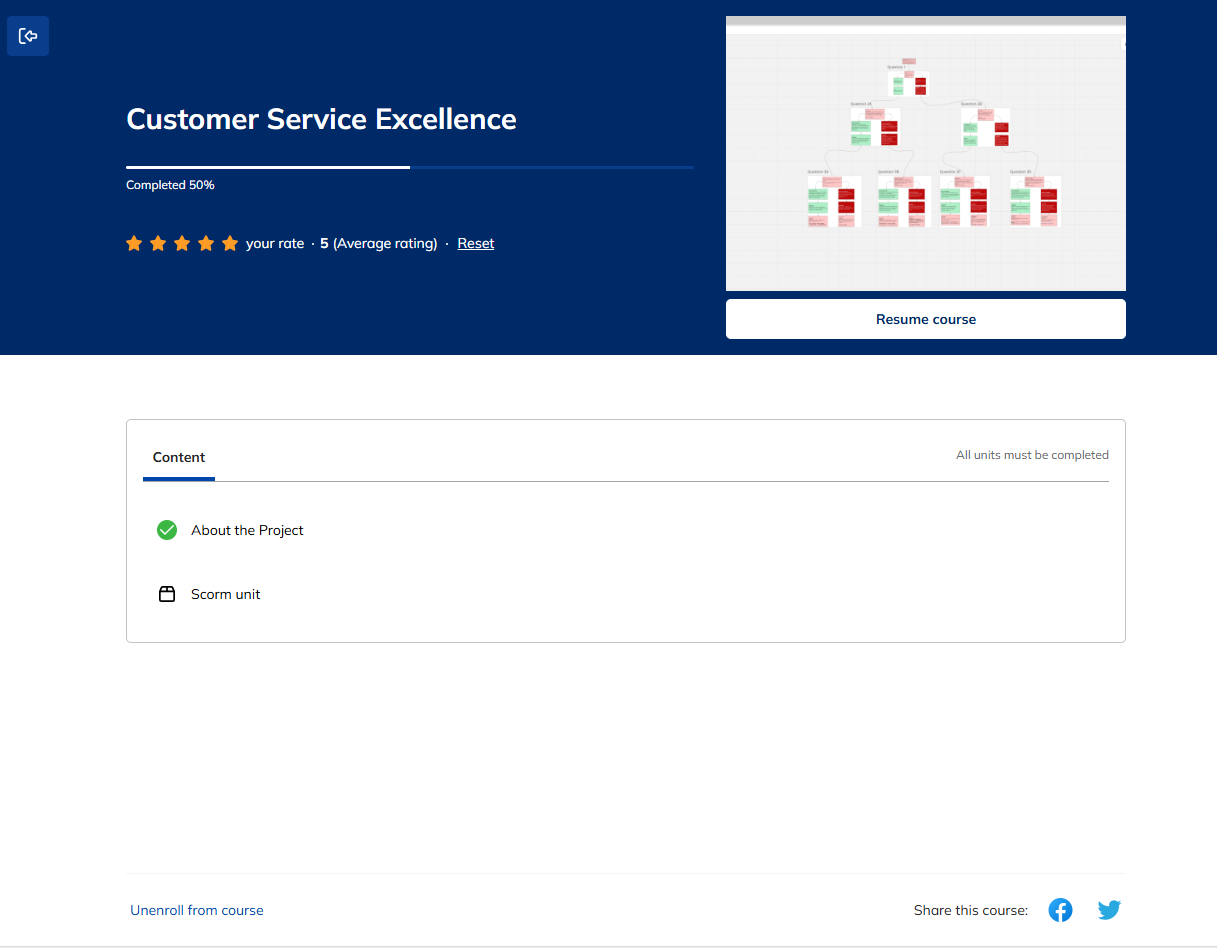
LMS course interface for Customer Service Excellence simulation.

To measure effectiveness, I combined quantitative and qualitative methods.

The feedback informed iterative design improvements and validated the course’s emotional learning approach.

Implemented in a real organizational context. Company name and data withheld for confidentiality.

After deployment, the Customer Service Excellence simulation achieved measurable improvements across key service metrics. Within two weeks of launch, nearly all frontline employees completed the training and reported noticeable growth in confidence and communication tone.

Course Completion
0 %
Learner Confidence Increase
0 %
Positive Manager Feedback
0 %

Implemented in a real organizational context. Company name and data withheld for confidentiality.

Designing this simulation deepened my understanding of how feedback loops and emotional cues shape learner behavior. By visually connecting each choice with its emotional impact, I was able to promote real empathy and decision-making practice. This project also reinforced the importance of usability testing even small layout adjustments improved navigation and learner engagement.

If I were to enhance this project further, I would: